


Tendencias y perspectivas futuras de la industria de baterías de níquel-metal hidruro (2026-2030)
Autor: Equipo de I+D e Investigación de Mercado de Weijiang Energy | Fuente de datos: GEP, Straits Research, Reglamento UE 2023/1542, Políticas del MIIT 2025 | Tiempo de lectura: 10 minutos
En el contexto de la neutralidad de carbono global y la creciente demanda de almacenamiento de energía, la industria de las baterías de níquel-metal hidruro (NiMH) está entrando en un ciclo de diferenciación estructural. A diferencia de las baterías de iones de litio, centradas en vehículos totalmente eléctricos, las principales ventajas competitivas de las NiMH residen en su amplia adaptabilidad a la temperatura, su seguridad intrínseca, su fabricación con bajas emisiones de carbono y su alta reciclabilidad. Este documento analiza datos verificados del mercado global, rutas tecnológicas iterativas, dos marcos normativos regionales clave (la nueva política energética de China y las normas de economía circular de la UE), trayectorias de crecimiento segmentadas y la lógica de inversión para inversores del sector, investigadores de políticas y responsables de la toma de decisiones en el sector de los fabricantes de equipos originales (OEM).
La percepción tradicional de que las baterías de níquel-metal hidruro (NiMH) son un producto de consumo en declive ha cambiado gracias a sectores emergentes como los vehículos híbridos, el almacenamiento de energía industrial y la alimentación de respaldo para vehículos y aplicaciones polares. Analizamos datos reales de la industria, en lugar de predicciones vagas, para esclarecer la trayectoria de desarrollo a cinco años y las oportunidades de crecimiento ocultas del sector NiMH.
1. Escala del mercado global de baterías NiMH y datos de crecimiento segmentado (2025-2030)
Indicadores clave del mercado global
| Segmento de aplicación | Cuota de mercado en 2025 | Tasa de crecimiento anual compuesta (CAGR) 2025-2030 | Motor principal de crecimiento |
|---|---|---|---|
| Vehículos híbridos HEV | 47,5% | 9,1% | Crecimiento de la penetración global de vehículos híbridos |
| Almacenamiento industrial y de energía | 18,9% | 11,5% | Regulación de la frecuencia de la red, respaldo de la estación base |
| Equipo especial extremo | 16,4% | 10,8% | Polar, desierto, potencia T-BOX del vehículo |
| Herramientas eléctricas y médicas | 12,2% | 4,3% | Demanda estable de reemplazo maduro |
| Pequeños dispositivos de consumo | 5,0% | 2,8% | Crecimiento lento, contracción del mercado |
Análisis clave del sector: Los mercados de baterías NiMH para el consumidor se están reduciendo gradualmente, mientras que las fuentes de alimentación para la industria, la automoción y entornos extremos se consolidan como sectores clave de alto crecimiento. El sector está pasando de la competencia por volumen a soluciones NiMH personalizadas de alto valor y amplio rango de temperatura.
Dos tendencias clave en la innovación tecnológica de las baterías NiMH
La inversión en I+D de las empresas globales de NiMH se centra en cuatro rutas técnicas principales, con plazos de comercialización claros respaldados por datos de laboratorio y de producción en masa:
2.1 Celda de baja autodescarga y amplio rango de temperatura (producción en masa madura)
El electrolito anticongelante compuesto, sumado a la aleación de almacenamiento de hidrógeno AB5 modificada, resuelve la cristalización del electrolito a -40 °C. Las celdas producidas en masa logran una descarga estable desde -40 °C hasta 85 °C, con una tasa de autodescarga mensual inferior al 8 %. Esta tecnología constituye la principal ventaja competitiva de las fábricas OEM chinas para sistemas T-BOX, de exploración polar y de almacenamiento solar en desiertos, y está totalmente integrada en la gama de producción en masa AAA/AA/SC de Weijiang.
2.2 Materiales de aleación de grado industrial de alto ciclo
La nueva aleación bimetálica de tierras raras alcanza más de 5000 ciclos de carga y descarga superficiales en condiciones de funcionamiento de vehículos híbridos eléctricos, superando con creces los requisitos de la norma IEC 61951. La tecnología de recubrimiento de electrodos en seco reduce el consumo energético de fabricación en un 68 % y elimina la descarga de aguas residuales, cumpliendo con los estándares globales de certificación de fábricas sostenibles.
2.3 Popularización del sistema inteligente de gestión de edificios (BMS)
Los algoritmos de ecualización adaptativa mediante IA controlan la desviación de voltaje de cada celda dentro de ±5 mV, lo que mejora la vida útil general del paquete en un 15 %. El sistema de gestión de baterías (BMS) con sensor de temperatura NTC se convierte en la configuración estándar para paquetes de NiMH de amplio rango de temperatura para vehículos e industria.
2.4 Baterías de NiMH de estado sólido (desde laboratorio hasta proyecto piloto a medio plazo)
El electrolito de polímero sólido reemplaza la solución alcalina líquida; la densidad energética en laboratorio alcanza los 180 Wh/kg. El consenso de la industria predice una producción de prueba en lotes pequeños entre 2028 y 2031, lo que redefinirá los patrones de competencia en el mercado de baterías industriales de alta gama tras la producción en masa.
3. Marco normativo: Impacto de la nueva política energética de China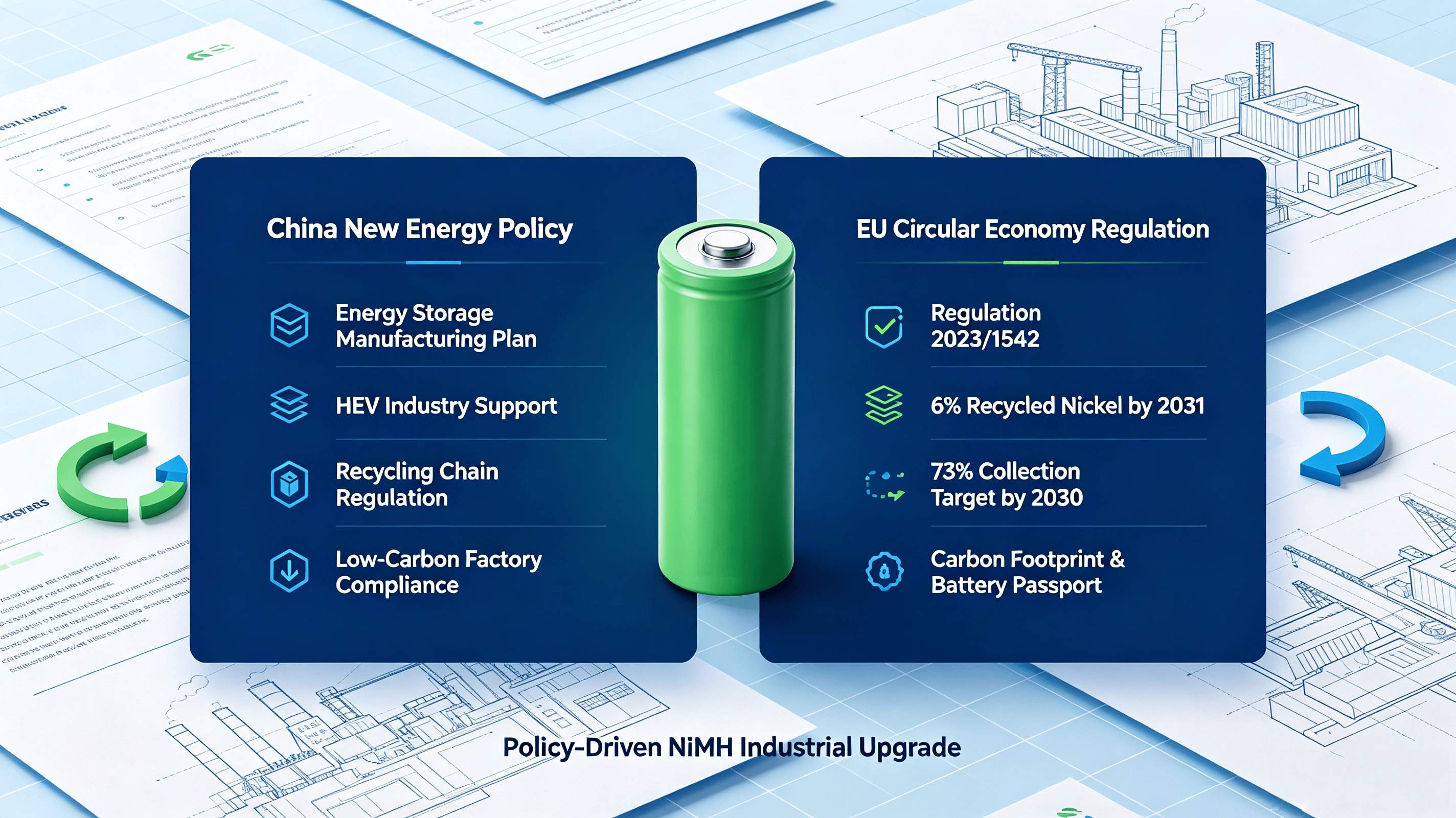
Documentos clave de la política china (publicación oficial de 2025)
- Plan de acción para el desarrollo de alta calidad de la fabricación de nuevos sistemas de almacenamiento de energía (2025-2030) : La tecnología NiMH está designada como tecnología clave de almacenamiento de energía segura a corto y medio plazo; se apoyan las líneas de producción de celdas automatizadas de amplio rango de temperatura con subsidios fiscales.
- Plan para la industria de vehículos de nueva energía (2026-2035) La ruta técnica de los vehículos híbridos eléctricos (HEV) recibe un apoyo político sostenido, lo que crea una demanda nacional estable de vehículos de NiMH.
- Especificaciones revisadas de la industria NiMH : Indicadores cuantitativos claros sobre las emisiones de carbono de la producción y la tasa de reciclaje de baterías, lo que obliga a las pequeñas fábricas a abandonar el mercado.
- Medidas de gestión para el reciclaje de baterías usadas : Estandarizar la cadena industrial de recuperación regenerativa de níquel y tierras raras, reduciendo la volatilidad de los costos de las materias primas para los fabricantes.
Análisis de los beneficios de las políticas: La política interna china conforma un ciclo cerrado de "apoyo a la producción + demanda posterior + sistema de reciclaje", lo que acelera la concentración de la industria de las baterías de níquel-metal hidruro (NiMH). Los principales fabricantes, con capacidad integral de I+D y empaquetado personalizado, ampliarán continuamente su cuota de mercado; las pequeñas fábricas que carecen de tecnología para un amplio rango de temperaturas y de sistemas de reciclaje adecuados se enfrentarán a la presión de la eliminación después de 2027.
4 Requisitos del Reglamento de la UE sobre baterías para la economía circular (Restricción fundamental para las exportaciones mundiales)
El Reglamento (UE) 2023/1542, que entrará en vigor plenamente en 2027, establece normas vinculantes sobre el ciclo de vida de todas las baterías importadas a Europa, lo que conlleva costes de cumplimiento, así como barreras y oportunidades de mercado para los fabricantes de baterías de NiMH:
- Contenido obligatorio de níquel reciclado: un mínimo del 6 % para 2031, que aumentará al 15 % en 2036, lo que generará una demanda estable de materias primas para el reciclaje de NiMH;
- Objetivo de recogida de baterías portátiles: tasa de recuperación del 73 % para 2030, estándar de recuperación de material NiMH fijado en el 80 %;
- Se requiere una declaración completa de la huella de carbono del ciclo de vida y un pasaporte de batería para los paquetes de NiMH industriales y automotrices exportados a la UE;
- Restringir las sustancias nocivas: Las baterías de NiMH, libres de cadmio, plomo y mercurio, ofrecen ventajas inherentes en cuanto al cumplimiento de la normativa frente a las baterías de litio y níquel-cadmio;
